WE RESPOND TO YOUR NEEDS 414-271-1440
When May Child Support Payment Obligations End in Wisconsin?
 In every divorce, legal separation, or paternity case involving children under age 18, the court will determine child support payments. After a court has entered an order for child support, the parent paying child support must continue doing so except in very specific circumstances. Not paying child support can lead to serious consequences, including criminal charges.
Very few parents do not want to financially support their children, but child support payments don’t always seem fair. Sometimes the parent making payments feels like they are too high or that the money isn’t being spent on the child. Perhaps the parent who receives the payments still doesn’t have enough to make ends meet, or is always having to chase down payments.
Whatever your situation may be, if you are dealing with child support payments in 2026, you need to know when and how they can be charged or terminated. Our Milwaukee child support attorneys help parents tackle even the most complicated child support issues. Call us today to talk about your case.
Who Pays Child Support in Wisconsin?
The parent who has the most placement (physical custody) typically, though not always, receives child support in Wisconsin. This is based on the idea that the parent who has primary placement of a child is supporting the child financially as part of the household.
However, both parents have a legal obligation to financially support their child. The income of both parents, as well as the time each child spends at each parent’s house, affects the amount of support payments.
How Long Do Child Support Payments Last?
Unless a child support agreement says otherwise, you are required by law to make child support payments until the child turns 18, or 19 if they are still in high school. In cases of children 18 or older who are dependent on their parents because of a mental or physical disability, child support payments can continue indefinitely. Many parents set up a trust or other system to make sure their disabled children get the support they need through adulthood.
When Can You Modify Child Support in Wisconsin?
Under Wisconsin Statute 767.59, either parent can file a motion to modify child support if there has been a "substantial change in circumstances" since the last order was entered. This means you must show that something meaningful has changed that affects the child's needs or a parent’s ability to pay. The court will not modify child support simply because one parent is unhappy with the current amount.
What Qualifies as a Substantial Change in Circumstances?
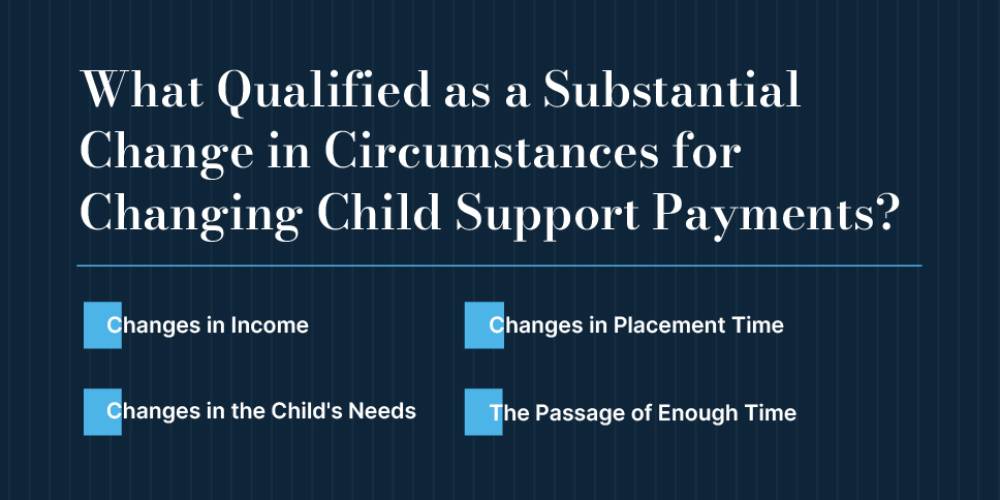
Several situations may qualify as a substantial change in circumstances that justifies modifying child support.
Changes in Income
If the paying parent loses a job, has hours reduced, or experiences a significant drop in income, this may justify lowering child support. On the other hand, if the paying parent receives a substantial raise or bonus, the receiving parent may request an increase. It is important to note that voluntarily quitting a job or reducing hours to avoid child support will not result in a reduction.
Changes in Placement Time
If the amount of time the child spends with each parent changes, child support may need to be adjusted. A parent who now has the child in their home more often may be entitled to receive support or to pay less. A parent who has the child less often may need to pay more.
Changes in the Child's Needs
As children grow, their needs change. Medical conditions, educational requirements, or other special needs may require more financial support. For example, if the child develops a condition that requires ongoing treatment or therapy, this could justify an increase in support.
Enough Time Passes
Even without a specific change in circumstances, Wisconsin law presumes that a substantial change has occurred if 33 months have passed since the last order and the new calculation would differ by at least 15 percent from the current amount. This allows parents to request updates to keep child support in line with current incomes and needs.
Can You Stop Paying Child Support if You Give Up Your Parental Rights?
One situation in which a parent may be able to stop making child support payments is if a court terminates parental rights. This can happen in a limited number of circumstances. Courts are very careful when considering whether to involuntarily terminate parental rights because of the serious impact on the parent/child relationship.
Wisconsin law technically does allow the voluntary termination of parental rights, but courts in the state do not often grant voluntary termination of parental rights either. Parents cannot simply stop making child support payments by giving up parental rights.
If Child Support Ends, Do I Still Owe Backpaid Child Support?
A court will continue to require a parent to make payment on arrearages, or unpaid child support, even if support payments have ended moving forward. Courts are very strict about child support payments and unpaid child support can’t even be wiped out in bankruptcy.
Can We Agree to Change Child Support Without Going to Court?
The U.S. Census estimates that roughly 35 percent of parents have an informal child support agreement. It can be very tempting to make a verbal or written child support agreement with your child’s other parent, especially if you have never been married. But this is a risky move.
If the other parent stops paying, or gets a better job and isn’t paying their fair share, getting the money you need for your child can be very difficult. Likewise, if you have always made cash payments but your child’s other parent goes to court and claims you never have, you may find yourself owing significant backpaid child support.
The best option is to have an attorney represent you in court so you can have a child support order handed down by the court. This order is enforceable and can be changed when the circumstances justify it.
Contact Our Wisconsin Child Support Attorneys
Even if you feel that your child support payments are unfair, you will still have to pay them until the court says you can stop. At Gimbel, Reilly, Guerin & Brown, LLP, we can help you find out exactly when that is. We can also help you petition a court to modify or lower your child support payments.
Our experienced Milwaukee, WI child support lawyers are here to explain your legal rights and obligations when it comes to child support. Contact our firm at 414-271-1440 to schedule a free family law consultation.